

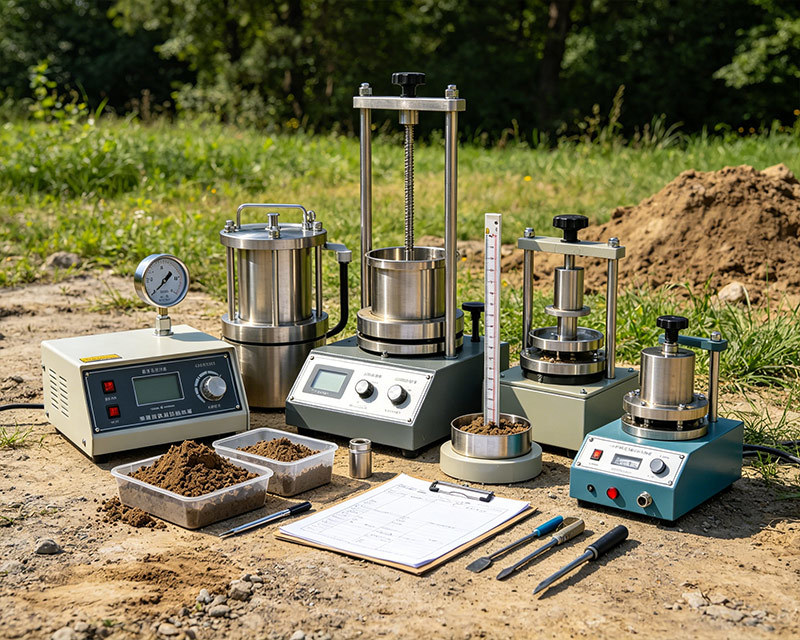


Geotechnical and Soil Testing Equipment

DLY-1 Coarse-Grained Soil Vertical Seepage Deformation Tester
This test complies with SL 237 and DL/T 5356, the test specifications for granular soils in hydropower and water conservancy engineering. The test method employs upward seepage flow and is suitable for granular soils, enabling the determination of parameters such as the soil’s coefficient of permeability, dry density, porosity, hydraulic gradient, and seepage velocity.
DLY-2 Coarse-Grained Soil Horizontal Permeability Deformation Tester
In accordance with the test method specified in DL/T 5356 “Test Procedure for Coarse-Grained Soils in Water Conservancy and Hydropower Engineering,” the permeation flow is directed horizontally, making this method suitable for coarse-grained soils.
DLY-3 Coarse-Grained Soil Triaxial Shear Testing Machine
Complies with GB/T 50123-2019 “Standard for Geotechnical Test Methods” and DL/T 5356 “Test Procedures for Coarse-Grained Soils in Hydropower and Water Conservancy Projects.”
DLY-4A Direct Shear Testing Apparatus for Coarse-Grained Soils
In accordance with GB/T 50123-2019, “Standard for Geotechnical Test Methods,” the stress-controlled direct shear test is employed and is suitable for shear testing of coarse-grained soils.
DLY-5 Coarse-Grained Soil Field Density Tester
This test method is applicable for in-situ determination of the density of coarse-grained and very coarse-grained soils. It complies with the standard GBT 50123-1999, “Geotechnical Test Methods.”
DLY-6 Coarse-Grained Soil Permeability Tester
In accordance with DL/T 5356, the Test Procedure for Coarse-Grained Soils in Hydropower and Water Conservancy Engineering, the double-ring pit‑infiltration method is employed and is suitable for unsaturated sandy soils and fine sands.
DLY-7 Coarse-Grained Soil In-Situ Water Injection Testing Apparatus
Applicable to water‑conservation and hydropower engineering geological investigations involving water‑injection tests.
DLY-8 Microcomputer-Controlled Stress–Strain Triaxial Tester
Designed and manufactured in accordance with GB/T 50123-2019, “Standard for Geotechnical Test Methods,” it is used to determine the shear strength, deformation characteristics, and pore water pressure of soil samples under constant-strain loading conditions.
DLY-9 Coarse-Grained Soil Field Load Testing Apparatus
Applicable to the DL/T 5356 Test Procedure for Coarse-Grained Soils in Hydraulic and Hydroelectric Engineering, as well as the SL 237‑1999 Geotechnical Testing Procedure, for tests involving materials with a maximum particle size of less than 60 mm.
DLY-10 Direct Shear Consolidation Tester for Coarse-Grained Soils
In accordance with GB/T 50123-2019 “Standard for Geotechnical Test Methods” and DL/T 5356-2006 “Test Procedure for Coarse-Grained Soils in Hydropower and Water Conservancy Projects,” the plane‑strain method with stress‑ and strain‑control is employed, making it suitable for shear testing of coarse-grained soils.
DLY-11 Coarse-Grained Soil Surface Vibration Compactor
For the determination of the maximum dry density of non-cohesive, freely draining soils, the compaction test often yields a bimodal or unimodal curve with no distinct peak, indicating that this method is no longer the most suitable for such soils.
DLY-12 Coarse-Grained Soil Compaction Apparatus
The test complies with GB/T 50123-2019, “Standard for Geotechnical Test Methods,” and is conducted in accordance with the requirements of SL 237, “Geotechnical Test Procedures” issued by the Ministry of Water Resources of the People’s Republic of China, as well as DL/T 5356, “Test Procedures for Coarse-Grained Soils in Hydraulic and Hydroelectric Engineering,” a standard of the electric power industry.
DLY-13 Coarse-Grained Soil Vibration Table Test Apparatus
This test apparatus was developed in accordance with the SL237-054-1999 and DL/T5356-2006 standards and is used to determine the relative density of coarse-grained soils.
DLY-14 Microcomputer-Controlled Consolidometer for Coarse-Grained Soils
Conforming to GB/T 50123-2019 “Standard for Geotechnical Test Methods” and DL/T 5356-2006 “Test Procedures for Coarse-Grained Soils in Hydropower and Water Conservancy Projects,” this equipment is used for consolidation tests on coarse-grained soils, enabling the determination of the relationship between soil pressure and deformation, as well as the calculation of parameters such as the unit settlement, compression index, rebound index, and consolidation coefficient.
DLY-15 Hydraulic Seal Material Flow Tester
This instrument is developed and manufactured in accordance with the DL/T 949 technical standard for plastic joint‑sealing materials used in hydraulic structures. It is designed to measure the flow‑stop water‑tightness length of such materials and to evaluate their flow‑stop performance. Featuring an elegant appearance and user‑friendly operation, it is well suited for research institutions, colleges, and universities.
DLY-16 Coarse-Grained Soil Constant Head Permeameter
The constant-head permeameter for coarse-grained soils is used to determine the soil’s coefficient of permeability and is suitable for coarse-grained soils and graded crushed stone with a maximum particle size not exceeding 75 mm.
LBT-0802 Geotechnical Strain-Controlled Direct Shear Apparatus (Large-Scale, 30 kN and 50 kN)
It is used to measure the direct shear frictional properties of structures under constant-strain control conditions.
CBR-1A Digital Display Bearing Ratio Tester
It is used to conduct the California Bearing Ratio (CBR) test on various soils and pavement base and subbase materials after preparing specimens in a designated test cylinder.
CBR-III Digital Display Bearing Ratio Tester
It is used to conduct the California Bearing Ratio (CBR) test on various soils and pavement base and subbase materials after preparing specimens in a designated test cylinder.
CBR-II Type Bearing Ratio Tester
It is used to conduct the California Bearing Ratio (CBR) test on various soils and pavement base and subbase materials after preparing specimens in a designated test cylinder.
The CBR water-immersion swelling appendix complies with the “Highway Subgrade Design Code” (JTJ013-95) and the “Highway Subgrade Construction Technical Specification” (JTJ033-95).
CLD-3 Static Cone Penetrometer
The CLD-3 static cone penetrometer uses mechanical transmission to press the probe into the soil at a constant rate.
DGJ-300 Single-Lever Consolidation Apparatus (Large Type)
It is used to measure the compressive behavior of structures under confined conditions. A pneumatic‑lever system applies consolidation pressure, offering a lightweight and convenient loading mechanism.
The in-situ foundation bearing capacity tester was already incorporated into international standards in the 1970s, known as the pocket penetrometer. In 1994, it was adopted into China’s national codes and is primarily used in civil and industrial construction, as well as for roads, bridges, and water‑conservation infrastructure. It enables rapid, on‑site, in‑situ testing—such as post‑excavation trench inspection—to determine the soil penetration resistance (P value), the foundation bearing capacity (R value), the modulus of elasticity (Es), and the liquidity index. The instrument is easy to operate: simply drill a single hole at the test location, insert the device vertically, and begin testing.
DSY-1 Type Butterfly Liquid Limit Apparatus (Manual)
In the disk-type liquid limit test, the soil paste in the soil dish is divided into two halves with a knife, and the dish is dropped from a height of 10 mm at a rate of twice per second.
DSY-2 Type Disc Liquid Limit Apparatus (Electric)
The soil paste in the dish is divided into two halves using a knife, and the dish is dropped from a height of 10 mm at a rate of twice per second.
GDB-1 Type Geotechnical Layered Saturator
A conventional apparatus suitable for preparing sandy soils and relatively permeable cohesive soils into saturated specimens.
GFG-1 Type Unsaturated Soil Single-Lever Consolidometer
It is primarily used to investigate the compressibility of unsaturated soils and is suitable for soil mechanics experiments conducted at institutions of higher learning.
The GJY-type KO consolidation apparatus is used to determine the at-rest lateral earth pressure coefficient for soil specimens with a diameter of 61.8 mm.
GSY-1 Type Water-Filling Method Bulk Density Tester
The water‑filling method test apparatus is used on site to determine the density of coarse-grained and very coarse-grained soils.
Whether you want to customize product features
I still need some examples to refer to ——
Please let us know what you're looking for, and we'll send you relevant materials to help you move your project forward quickly!
Global Partners
Customer Satisfaction
Committed to becoming a leader in China's testing equipment manufacturing industry
Share To


