




Geotechnical and Soil Testing Equipment

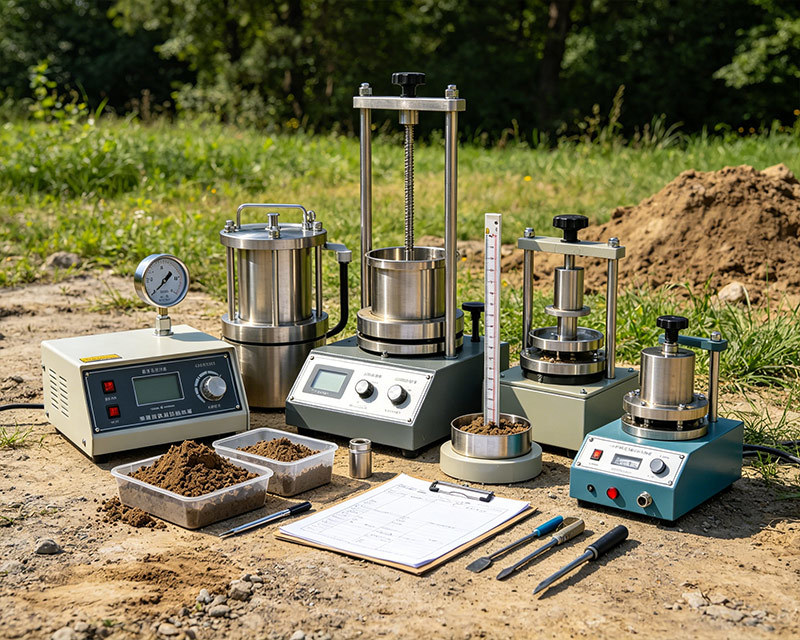
LBT-Y5 Direct Shear Consolidation Integrated Testing Machine for Coarse-Grained Soils
The direct shear–consolidation apparatus for granular soils is used to determine the shear strength of granular soils. It employs soil specimens subjected to vertical confining pressure, with shear force applied to induce shearing, thereby measuring the shear stress and shear displacement at failure. This instrument utilizes a controller to automatically regulate a synchronous motor, reducing manual labor, minimizing experimental errors, and ensuring convenient operation, stable speed, and reliable, consistent test data.
LBT-Y6 Microcomputer-Controlled Consolidation Testing Machine for Coarse-Grained Soils
Compliant with GB/T 50123‑2019 “Standard for Geotechnical Test Methods” and DL/T 5356‑2006 “Test Procedure for Coarse-Grained Soils in Hydropower and Water Conservancy Projects,” this instrument is designed for consolidation testing of coarse-grained soils, enabling the determination of the relationship between soil pressure and deformation, as well as the calculation of parameters such as unit settlement, compression index, rebound index, and consolidation coefficient. Product features: The LBT‑Y6 microcomputer‑controlled consolidation tester for coarse-grained soils incorporates an integrated, non‑sinking frame, eliminating the need for a pre‑constructed foundation or pit‑embedded installation. It employs a high‑quality radial piston servo pump and dual‑control digital valves, ensuring stable pressure regulation with virtually no noise. Equipped with built-in mold‑moving rails and positioning devices, it simplifies mold installation and alignment. An independent servo control cabinet houses a 19‑inch industrial embedded tablet PC. Powered by renowned manufacturer‑developed test software, it supports specimen testing, graphing, data acquisition and analysis, report generation, and other functions.
LBT-Y7 Coarse-Grained Soil Microcomputer-Controlled Direct Shear Testing Machine
Using coarse-grained soil specimens, shear tests are conducted under vertical confining pressure by applying shear forces, and the shear stress and shear displacement at failure are determined. The testing apparatus consists of three main components: a four-column loading frame, a hydraulic pump station system, and a microcomputer control system. The loading frame comprises a base, support columns, a crossbeam, a vertical loading hydraulic cylinder, a horizontal loading hydraulic cylinder, a shear box, ball bearings, guide rails, and other elements.
LBT-Y8 Microcomputer-Controlled Triaxial Shear Testing Machine for Granular Soils
This testing machine is used to determine the shear strength, deformation characteristics, and pore water pressure of soil samples under constant-strain loading conditions. The system can perform unconsolidated–undrained (UU), consolidated–undrained (CU), and consolidated–drained (CD) tests, among others.
The double-ring test is a commonly used, simple field method for determining the hydraulic conductivity of unsaturated, loose rock layers in the vadose zone, and its results more closely reflect actual conditions. Utilizing data from this test is of great importance for studying regional water balance as well as assessing seepage losses from reservoirs, irrigation districts, and canals.
The double-ring test is a commonly used, simple field method for determining the hydraulic conductivity of unsaturated, unconsolidated layers in the vadose zone, and its results more closely reflect actual conditions. Utilizing data from this test is crucial for studying regional water balance as well as assessing seepage losses from reservoirs, irrigation districts, and canals.
Whether you want to customize product features
I still need some examples to refer to ——
Please let us know what you're looking for, and we'll send you relevant materials to help you move your project forward quickly!
Global Partners
Customer Satisfaction
Committed to becoming a leader in China's testing equipment manufacturing industry
Share To


Contact Us
Mobile:+86-15102211717
Whatsapp:+86-15102211717
E-mail:lbt@lbt.ltd
Address:Tianjin Jinghai Economic Development Zone