




Paint and Coating Testing Equipment

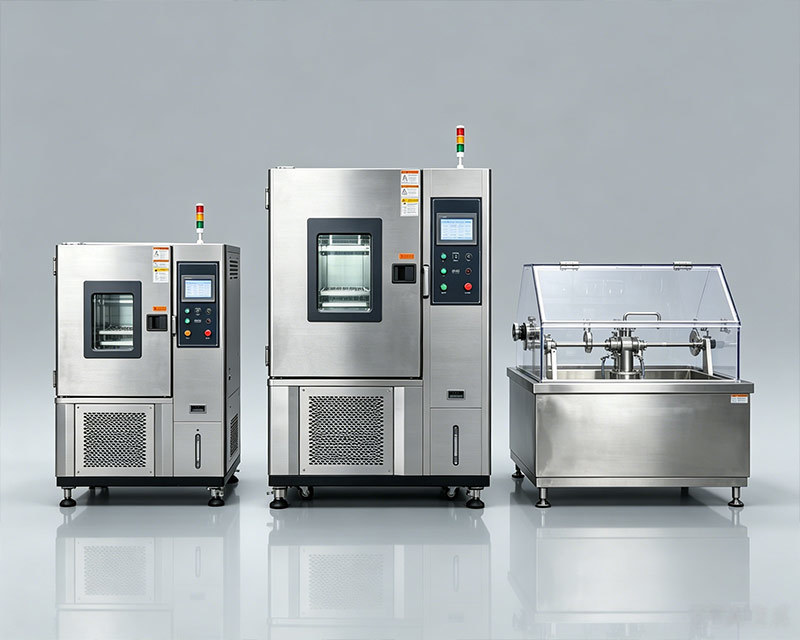
LUV Paint and Coating UV Aging Test Chamber
This apparatus is suitable for accelerated aging tests conducted under exposure to light and water, enabling the prediction of the relative durability of nonmetallic materials such as paints, coatings, and plastics. It is particularly well suited for monitoring the degradation of highly durable materials, including reductions in gloss, haze formation, loss of strength, chalking, cracking, blistering, embrittlement, and fading.
Measurement of the bulk density and flowability of metal powders using a funnel under standard conditions.
NWZ-Stain Resistance Tester for Coatings
Used for laboratory evaluation of the cleanability (also referred to as washability) of architectural coating surfaces.
QAG Paint Flow-Resistance Tester
The relative sag resistance of a coating is determined by applying, with a doctor blade, strip‑shaped wet films of varying thicknesses onto glass test panels. The panels are then immediately positioned vertically so that the film exhibits a “thinner on top, thicker at the bottom” profile. After the film has dried, its sag resistance is assessed, expressed as the maximum film thickness in micrometers at which no sagging occurs.
QBB Coating Specific Gravity Cup
Applicable standards: GH6750 and ISO 2811. These standards are used to determine the density of paints and varnishes, where density is defined as the mass per unit volume at a specified temperature. Density cups are employed for quality control, as compositional deviations in coatings can result in inconsistent density readings.
QBJ Digital Display Cupping Tester
This standard is applicable to the evaluation of coatings—whether single-layer or multi‑coat systems—of paints, varnishes, and related products. Under the test methods specified in the standard, a compression‑indentation test is conducted; after the coating undergoes progressive deformation, its resistance to cracking or to delamination from the metal substrate is assessed, thereby determining whether the coating passes or fails.
QBY-II Pendulum Coating Hardness Tester (with Timing)
The QBY‑II pendulum‑type paint film hardness tester is an upgraded version of the QBY pendulum‑type hardness tester. Its key features include an improved horizontal mechanism; a scale that can be moved horizontally, facilitating zero‑point adjustment; and, when paired with a photoelectric counter, it delivers fast, accurate results while saving labor.
QCJ-40 Paint Film Wood Impact Tester
It is suitable for evaluating the impact resistance of surface paint films on wooden furniture components and can be used to test materials of any thickness.
QCJ-120 (120A, 120B) Paint Film Impact Tester
Product Description: The QCJ‑120 (120A, 120B) series paint film impact testers are used to determine the impact resistance of paint films by measuring the maximum height—120 cm—at which a hammer of fixed mass can fall onto a test panel without causing damage to the coating. After the impactor strikes the test panel, no secondary rebound occurs.
QCJ Coating Film Impact Tester
The paint film impact tester is used to evaluate the ability of topcoats, clear coats, or related products to resist delamination or cracking from the substrate when subjected to impacts from different spheres under standardized test conditions. This assessment reflects both the mechanical strength of the coating and its adhesion to the substrate.
QCT Thick Paint Putty Consistency Tester
It is designed in accordance with the national standard GB 1749‑79 and is used to determine the consistency of thick paints or putties, offering simplicity, intuitiveness, and accuracy.
QDK Automatic Dynamic Crack-Resistance Tester
Due to factors such as uneven moisture–drying cycles, thermal expansion and contraction, structural settlement, and deficiencies in design and construction, nearly all buildings exhibit surface hairline cracks, surface through‑going cracks, and structural cracks to varying degrees.
QFD Electric Coating Adhesion Tester
The circular‑trajectory method is used to determine the adhesion performance of paint films, assessing the ability of various coatings to adhere to the substrate surface.
QFH Cross‑Hatch Adhesion Tester, Cross‑Hatch Cutter, and Film‑Cutting Kit – Product Description The adhesion tester, also known as the cross‑hatch cutter, is designed and manufactured in accordance with ISO 2409:1992. It complies with GB/T 9286‑98 and BS 3900 E6/ASTM D3359 standards and is primarily used for determining the adhesion of organic coatings using the cross‑hatch method. This instrument is suitable not only for laboratory use but also for on‑site applications under a variety of conditions.
QFM Coating Abrasibility Tester
This instrument is primarily used to determine the grindability of interior putties applied to interior walls, ceilings, and other indoor surfaces.
It is primarily used to determine the solvent resistance of coatings on aluminum‑plastic composite panels and can also be applied to assess the solvent resistance of coatings on other similar substrates. This instrument features a well‑designed structure, reliable performance, simple operation, and automatic counting.
QFS Coating Washability Tester
The paint washability tester is an instrument used to evaluate the washability of coatings. It can also be employed to assess the washability of any surface that has undergone thin-film coating or composite treatment.
QFZ Coating Adhesion Tester (Manual)
The circular‑trajectory method is used to determine the adhesion performance of paint films, assessing the ability of various coating films to adhere to the surface of the substrate.
QGS Paint Film Drying Time Tester
This product is used to determine the drying time of paint films and putty films.
QGY Coating Film Stackability Tester
This instrument is suitable for measuring the resistance to damage of single-layer coatings, such as lacquers and varnishes, or related products, as well as composite coating systems, after they have been fully dried within the specified drying time, when two coated surfaces, or one coated surface in contact with another type of surface, are subjected to compressive conditions.
QGZ-24 Automatic Paint Film Drying Time Tester
Determining the Drying Time of Paint Films and Putty Films To gain a comprehensive understanding of the drying and curing processes of coatings, an instrument capable of automatically measuring the entire drying period is required. This enables test personnel to obtain accurate and efficient scientific data. The design principle involves using a single-chip microcomputer to control a high-precision stepper motor, which drives a rocker arm equipped with a spherical contact point. Under a specified load and at a constant speed, a stylus performs uniform circular motion on the surface of the coating being tested. By recording the stylus’s trajectory on the coating surface and overlaying it onto a drying-time graph, the complete film-forming process can be evaluated.
QGZ-A2 Intelligent Linear Drying Time Recorder
The intelligent linear drying-time recorder enables comprehensive analysis of samples with diverse drying‑time characteristics.
QGZ-A Linear Paint Film Drying Time Tester
It measures the drying time of paint films and putty films. For various coatings—such as colored paints and clear varnishes—applied to surfaces, it can automatically and continuously display the state of each stage in the drying process along a straight-line trajectory, enabling intuitive analysis of the time required for each stage.
This instrument is used for sampling and testing of paints, varnishes, and related products to determine the film hardness of such coatings.
QHQ-A Portable Pencil Hardness Tester
The test method for determining the hardness of a paint film by means of the pencil hardness scale, which involves scratching through the paint film, is characterized as follows: Hardness is expressed in terms of the pencil hardness grade at which the paint film is scratched through under specified test conditions.
QHQA Electric Pencil Hardness Tester
Specifically designed for hardness testing of coatings on various finished products, such as mobile phone casings, MP4 player housings, laptop enclosures, and other appliance and digital‑product casings. The machine features electric (semi‑automatic) control and employs a stepper motor to drive the transmission, enabling precise forward and backward motion with low noise and high stability. The test stroke is adjustable to meet specific requirements.
QHQ Desktop Pencil Hardness Tester
The test method for determining the hardness of a paint film by means of the pencil hardness scale, which involves scratching through the paint film, is characterized as follows: Hardness is expressed in terms of the pencil hardness grade at which the paint film is scratched through under specified test conditions.
This instrument is suitable for indentation testing of single‑layer or multi‑layer coatings, whether pigmented or clear. It is designed solely to measure the resistance of a coating surface to plastic deformation. When the instrument applies a specified load under prescribed conditions, an indentation is produced; the indentation length serves as the basis for expressing the results of the indentation resistance test. As the desired performance of the coating—namely, its resistance to indentation—improves, the measured indentation resistance value increases.
QHZ Coating Film Scratch Tester
Film strength, hardness, adhesion, and other properties are critical physical characteristics of coatings, and their magnitude directly influences the coating’s key performance attributes.
QKL Initial Drying Crack-Resistance Tester
It is primarily used to assess the early‑stage drying and crack‑resistance performance of multi‑layer architectural coatings. The instrument employs an axial‑flow fan for air delivery, with stepless speed control.
Whether you want to customize product features
I still need some examples to refer to ——
Please let us know what you're looking for, and we'll send you relevant materials to help you move your project forward quickly!
Global Partners
Customer Satisfaction
Committed to becoming a leader in China's testing equipment manufacturing industry
Share To


Contact Us
Mobile:+86-15102211717
Whatsapp:+86-15102211717
E-mail:lbt@lbt.ltd
Address:Tianjin Jinghai Economic Development Zone