







Paint and Coating Testing Equipment

Structural Adhesive Density Meter
The determination of density is used for measuring the density of architectural sealant materials.
T-impact peel strength tester for structural adhesives
This instrument is suitable for determining the T‑impact peel length, an important indicator of the toughness of room‑temperature‑curing structural adhesives. A T‑impact peel specimen is prepared by bonding a pair of thin mild‑steel sheets; under specified conditions, an impact force is applied to the unbonded end of the specimen, causing delamination along the bond line. Structural adhesives with differing toughness exhibit markedly different peel lengths, allowing their relative toughness to be assessed. By measuring the peel length and conducting comparative analyses of test data for various adhesive grades, it is possible to establish a simple, practical acceptance criterion for structural adhesive toughness, based on peel length.
Tensile Bond Strength Test Fixture for Structural Adhesives
The tensile bond strength test fixture for structural adhesives is designed for laboratory conditions to determine the direct tensile bond strength of reinforcing materials bonded to substrates using structural adhesives, interface agents, or polymer mortars—whether applied by coating, spraying, pouring, or other methods—under uniform tensile stress, resulting in cohesive, adhesive, or mixed failure modes.
Elastic Recovery Rate of Pavement-Heating Sealant Under Penetration Ball Load
The penetration ball for the elastic recovery rate of pavement‑heating sealants is used to determine, under specified conditions, the percentage of deformation that a sealant specimen can recover, and is employed in conjunction with an asphalt penetration tester.
Low-Temperature Tensile Specimen Fixture for Pavement-Heating Sealant
Used in conjunction with a tensile testing machine for low-temperature tensile tests of asphalt joint sealant.
Penetration of pavement-heating sealant
The standard cone for the penetration test of pavement‑heating sealants is used in conjunction with an asphalt penetration tester to determine the sealant’s penetration depth—defined as the vertical distance, in 0.1 mm increments, that the standard cone penetrates into the sealant specimen. The cone has a smooth surface and a precisely calibrated weight.
Sealant Structural Adhesive Extruder Bracket
This bracket is designed to secure structural adhesive extruders, allowing three extruders to be suspended simultaneously, thereby facilitating connection during testing, ease of operation, and convenient storage after the experiment.
Grid-line architectural sealing material transparent membrane
Transparent film with a 1 mm grid is used to measure and calculate the bonded‑failure area in tensile tests. By placing this transparent film over the printed 1 mm × 1 mm grid, the number of grid squares occupied by the larger bonded‑failure area on each of the two bonded surfaces of the tensile‑bond specimen is counted, with precision to one grid square (fractions of a square are disregarded). The bonded‑failure area is expressed as the percentage of grid squares that have failed, relative to the total number of grid squares.
CZY-01 Pressure-Sensitive Adhesive Tape Initial Adhesion Tester
It is primarily used for testing the initial adhesion of products such as adhesive tapes, labels, protective films, and medicated plasters. A steel ball is rolled across the adhesive side of a tape laid flat on an inclined plate, and the maximum size of the steel ball that can be retained by the adhesive surface over a specified length is measured to assess its initial adhesion. The test inclination angle can be freely adjusted to meet user requirements.
Hexagonal Comb-Style Wet Film Thickness Gauge
A wet-film thickness gauge is a tool used to measure the coating thickness of various types of paints, such as colored paints and clear varnishes, during application.
ABC coating mold forming frame
It is suitable for determining the tensile strength, elongation at break, and low-temperature flexibility of elastic architectural coatings. Specimens of a specified thickness are prepared. The device is constructed from stainless steel, ensuring easy cleaning and straightforward operation.
BGD 245 Intelligent Scraper Fineness Tester
One reason is that, when applying the sample by scraping it into the groove of the scraper blade, variations in force and speed occur among different operators. Another reason is that, during readings, judgments regarding particle count and distribution are subject to considerable subjectivity—particularly when rapid results must be obtained within 5 seconds or when using low‑range scraper blades (e.g., those with a range of 0–25 μm).
It can be used to match colors of paint films under a specific light source.
BZT Non-Stick Tire Aging Tester
It is primarily used to determine the non‑stick tire drying time of “ambient‑temperature marking coatings” and “heated marking coatings” as specified in GA/T 298‑2001 (Road Marking Coatings).
The instrument reading for determining the hiding power of white and light-colored paints is directly proportional to the intensity of light reflected from the surface being tested.
DM-III Putty Abrasibility Tester
It is used to evaluate the sandability of primers and putties (by repeatedly sanding test samples of the primer or putty; the number of sanding cycles can be read directly from a counter. Based on the applied load, the number of sanding cycles, and the degree of wear, the sandability performance of the primer or putty can be assessed).
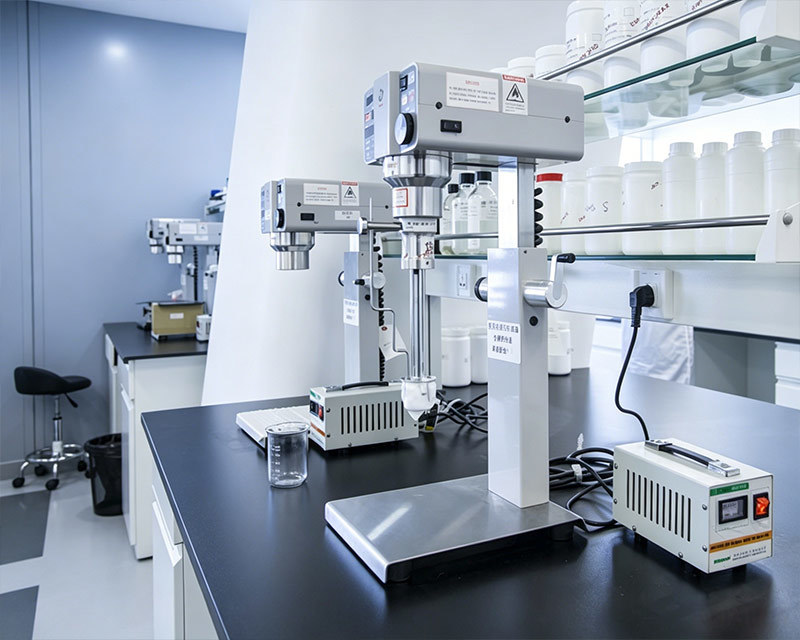
FJ200S Digital Display High-Speed Homogenizer
Suitable for experimental applications in liquid–liquid mixing and emulsification, as well as liquid–solid dispersion and slurry preparation, across fields such as biology, physicochemical analysis, cosmetics, health supplements, and food.
GBT 9265 Container for Testing Alkali Resistance of Coatings
The entire structure is made by plastic fusion welding, offering resistance to acids and alkalis, watertight integrity, and enhanced durability.
GJ-3S Digital Display Multi-Axis High-Speed Mixer
This is suitable for high-speed stirring of various liquids, with motor control achieved via an electronic speed controller that provides stepless speed regulation. The actual stirring speed is displayed digitally on the controller’s panel.
Measurement of surface gloss for materials such as marble, granite, vitrified polished tiles, and ceramic tiles.
HKST-1000Z Touchscreen Digital Display Pencil Hardness Tester
This digital, auto‑turret pencil microhardness tester is a new‑generation, multifunctional touchscreen model developed by our company, specifically designed for measuring pencils.
JCT2663 Coating Film Water Absorption Test Specimen Holder
Product Introduction: JCT2663 Coating Water Absorption Specimen Holder. The coating water absorption specimen holder is used for testing the water absorption properties of coatings in architectural waterproofing applications.
The instrument is driven by a stepper motor and features an LCD display that shows operating parameters and status. It is easy to operate, highly reliable, and offers flexible, convenient use. Depending on the requirements of the test sample, grinding wheels made from different materials can also be employed.
LB-10S Coating Adhesion Tester
The coating adhesion tester features a mechatronic design, with the entire instrument integrated into a single unit. It comprises mechanical components such as a handle, a high-precision S-type load cell, a lead screw, and a reaction support, arranged in a “gate”‑shaped configuration. Additionally, the measurement and display circuitry is embedded within the device, enabling direct data readout. The tester is lightweight, easy to operate with the handle, and convenient to use.
LBT 162 Intelligent Touch-Controlled Rotational Viscometer
The intelligent touch‑controlled rotational viscometer is an upgraded replacement for the original digital viscometer. It features a powerful 7‑inch high‑definition touchscreen with an intuitive human–machine interface, offering convenient operation and rich display information, making it an advanced instrument for measuring liquid viscosity.
LBT 184 Digital Storax Viscometer
The LBT 184 digital Strokes viscosity meter is a well‑established model. To operate, simply lower the instrument’s handle, immerse the stirring paddle to the specified depth in the sample being tested, and read directly on the device the sample’s KU value (Krebs) along with its corresponding load value.
LB-X280 Coating Flowability Tester
The line-marking coating flowability tester is an instrument used to measure the flowability of thermoplastic coatings.
LBT-JFS Series Variable-Frequency Multi-Purpose Dispersion Machine (Three-Phase Asynchronous Motor)
High-efficiency variable-frequency stirring and dispersing machine—this product series delivers exceptional performance while being energy-saving and environmentally friendly. It features a novel design, an attractive appearance, low noise levels, a compact structure, and convenient operation and maintenance. The high-speed stirring and dispersing machine is suitable for rapidly mixing, dissolving, and dispersing liquid and liquid–powder materials in industries such as coatings, dyes, inks, pigments, cosmetics, resins, adhesives, emulsions, pharmaceuticals, and petroleum, with speed adjustable over a wide range (0–2,800 rpm).
LBT-JFS Series Variable-Frequency High-Speed Multipurpose Disperser
The JFS series high-speed variable-frequency dispersers, driven by a high-speed motor, generate rotating tangential velocities. Under the action of intense centrifugal force, the materials undergo powerful hydrodynamic shear and high‑frequency mechanical effects, subjecting the fluid to thousands of shear cycles and high‑frequency mechanical actions per minute, thereby achieving efficient mixing, dispersion, and homogenization. Integrating both dispersion and stirring functions, this equipment combines dispersion and homogenization into a single process carried out in one machine and one vessel.
LBT151-1 Dial-Type Rotational Viscometer
This is one of the most basic and earliest‑used rotational viscometers, equipped with four rotor sizes—Nos. 1 through 4—and offering four selectable rotational speeds. Depending on the viscosity of the liquid being measured, different rotors and speeds are chosen: the higher the viscosity, the larger the rotor number and the lower the rotational speed.
Whether you want to customize product features
I still need some examples to refer to ——
Please let us know what you're looking for, and we'll send you relevant materials to help you move your project forward quickly!
Global Partners
Customer Satisfaction
Committed to becoming a leader in China's testing equipment manufacturing industry
Share To


Contact Us
Mobile:+86-15102211717
Whatsapp:+86-15102211717
E-mail:lbt@lbt.ltd
Address:Tianjin Jinghai Economic Development Zone