









Products

LBT-1A60 Emulsified Asphalt Solids Content Tester
In the field of solid content measurement, the trade-off between measurement accuracy and speed has long remained unresolved. In response to this situation, we present an instrument featuring a drying‑method design that enables rapid determination of solid content values.
LBT-1A61 Fourier Transform Infrared Spectrometer
The chemical composition of asphalt can be separated into four fractions: saturates, aromatics, resins, and asphaltenes. Variations in the relative concentrations of these fractions result in differences in asphalt’s properties. By employing a Fourier-transform infrared spectrometer and analyzing and comparing infrared spectra, rapid classification of asphalt can be achieved.
LBT-1A62 Reflux Asphalt Extractor
This method specifies a test procedure for determining the asphalt content in asphalt mixtures using the reflux extraction apparatus.
LBT-1A63 Emulsified Asphalt Testing Machine
Emulsified asphalt testing prior to the paving of micro-surfacing and slurry seal applications in the highway industry; formulation testing of water-based waterproof coatings in the waterproofing sector; and other emulsification tests conducted in the laboratory.
LBT-1A64 Emulsified Asphalt Evaporation Residue Content Tester
It is used to determine the asphalt content of residues remaining after thermal dehydration in various emulsified asphalts, according to JT/GE20/T065.
LBT-1A65 Automatic Low-Temperature Asphalt Brittleness Tester
This instrument is designed and manufactured in accordance with the requirements specified in GB/T 4510-2006 “Method for Determining the Brittle Point of Asphalt” of the People’s Republic of China, as well as T 0613-1993 “Asphalt Brittle Point Test (Fraass Method)” from the industry standard JTG 3410-2025 “Test Procedures for Asphalt and Asphalt Mixtures in Highway Engineering.” It is suitable for determining the Fraass brittle point of asphalt materials in compliance with the requirements set forth in GB/T 4510 and T 0613.
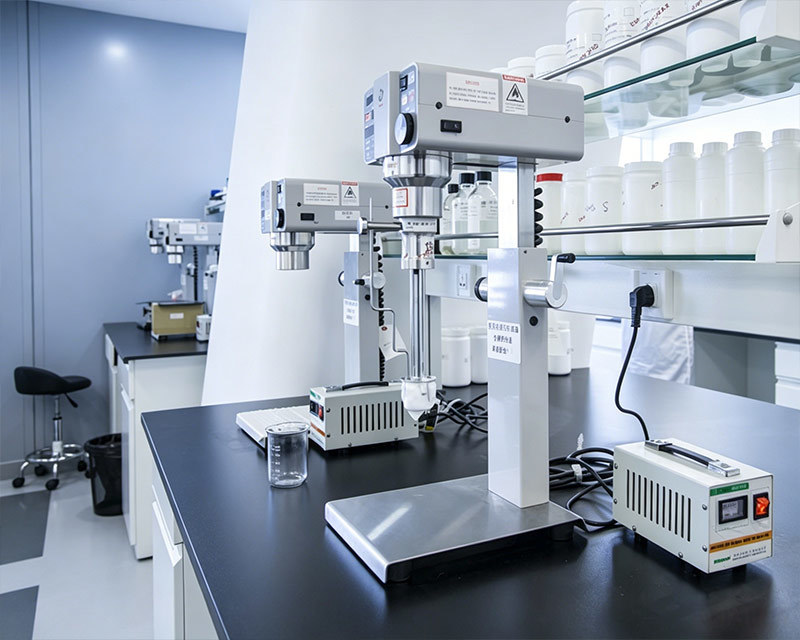
LBT-1A66 Emulsified Asphalt High-Speed Shear Mixer
The emulsifier employs a specially designed rotor and stator that, driven at high speed by the motor, draw the material to be processed into the rotor. The intense kinetic energy generated by the high‑frequency mechanical effects of the rotor’s rapid rotation subjects the material to a combination of powerful mechanical and hydrodynamic shearing, centrifugal extrusion, interlayer friction, high‑velocity impact‑induced rupture, and turbulent flow within the precise clearance between the stator and rotor. This process fragments, breaks down, and disperses the material, exposing it to hundreds of thousands of shear cycles in a matter of seconds. As a result, immiscible components are instantaneously and uniformly emulsified, finely dispersed, and dissolved. The emulsifier finds broad applications across numerous industries, including adhesives, paints and coatings, cosmetics, food, pharmaceuticals, textile dyeing, inks, and asphalt.
LBT-1A67 High-Speed Disperser for Modified Asphalt Testing
This laboratory high-speed disperser integrates dispersion and stirring functions, offering high efficiency, excellent mixing performance, and easy cleaning. Its manual lifting mechanism is simple and convenient, making it widely used in factories, research institutions, colleges and universities, and medical facilities for the dispersion, stirring, and blending of materials in liquids.
LBT-1A68 Fully Automatic High-Speed Modified Asphalt Emulsion Shearing Machine
The fully automatic high-speed modified asphalt emulsification shear machine is a newly developed, automatically controlled shear device in accordance with the JTG 3410‑2025 standard. It features automatic display and control of shear time, automatic display and regulation of heating temperature, and an automatic stop function at the upper limit of the shear head’s lifting position, ensuring safe and reliable operation. The machine is equipped with a fuse‑based overload protection system and thyristor‑controlled power electronics.
LBT-1A69 Asphalt Saybolt Viscosity Tester
This instrument is designed and manufactured in accordance with the requirements specified in T0623-2025, “Asphalt Saybolt Viscosity Test (Saybolt Heavy Oil Viscometer Method),” as outlined in the People’s Republic of China industry standard JTG 3410-2025, “Test Procedures for Asphalt and Asphalt Mixtures in Highway Engineering.” It is suitable for determining the Saybolt viscosity of asphalt at a specified constant temperature, as prescribed by the T0623-2025 standard.
LBT-1B56 Asphalt Solubility Tester (New Standard)
This instrument is designed and manufactured in accordance with the requirements specified in the People’s Republic of China standard GB/T 1148‑2008, “Method for Determining the Solubility of Petroleum Asphalt,” as well as those set forth in T0607‑2025, “Asphalt Solubility Test,” of the JTG 3410‑2025, “Test Procedures for Asphalt and Asphalt Mixtures in Highway Engineering.” It has been developed and produced to meet practical operational needs and is suitable for determining the solubility of residues remaining after evaporation of petroleum asphalt or emulsified asphalt (it is not applicable to the determination of the solubility of modified asphalt). This makes it an ideal analytical instrument for measuring the solubility of petroleum asphalt or emulsified asphalt in industries such as petrochemicals, construction, and highway engineering.
LBT-2010 Fully Automatic Electronic Water Permeability Tester for Asphalt Pavements
The fully automatic electronic water permeability tester is used for the automated and precise measurement of the water permeability coefficient of porous asphalt pavements, enabling evaluation of their water permeability and drainage performance.
NDJ-1C Digital Display Brinell Rotational Viscometer (New Standard)
The Brookfield rotational viscometer (high-temperature viscometer) features a concentric‑cylinder design, requires only 8–13 mL of sample, and delivers rapid, precise temperature control.
NDJ-1C Digital Display Brinell Rotational Viscometer
The NDJ-1C digital-display Brabender rotational viscometer/high‑temperature viscometer employs the latest microcomputer‑driven technology, an imported stepper motor, and an LCD with backlight. It features stable rotational speed, excellent accuracy, programmable operation, user‑friendly controls, and fault‑alert functionality. The display directly shows viscosity, rotational speed, percentage torque, rotor number, the temperature of the test fluid, and the measurement time.
LBT-1503 Low-Temperature Flexing Test Apparatus for Rubber- or Plastic-Coated Fabrics
The low-temperature bending test fixture for coated fabrics is used to expose rubber- or plastic-coated fabrics to a specified low temperature for a set duration, after which they are subjected to a bending test at a prescribed temperature to evaluate their resistance to low-temperature conditions.
LBT-1501 Warning and Uniform Flexibility Testing Machine
The LBT-1501 warning and uniform flexing testing machine is used to determine the flexural durability of rubber- or plastic-coated fabrics. It features digital setting and display of the number of flex cycles, automatic stop, and an integrated design that combines the main unit with the electrical control system. Each specimen can be clamped independently, and the machine boasts an attractive appearance and user-friendly operation, making it an improved domestic model.
LBTA-101E Retroreflectance Coefficient Meter
The retroreflectance coefficient tester for road signs is a new, portable device for assessing road traffic safety. It employs a standardized transfer‑based indirect measurement method and is specifically designed to evaluate the retroreflective optical performance of various reflective safety signs. The instrument is suitable for on‑site testing and inspection of road‑traffic reflective products, vehicle‑mounted safety reflectors, and industrial safety signage. Our company’s retroreflectance coefficient tester features an advanced optoelectronic integration, high precision, exceptional stability, and a cutting‑edge metal‑frame design. The system incorporates a 32‑bit MCU as its main control module and Linux‑based embedded programmable software, along with a built‑in high‑capacity storage unit and a touch‑screen display equipped with a soft keyboard for input. It offers user‑friendly characteristics such as no warm‑up required, minimal measurement error, and instant readiness for use.
LBT-1172 Handheld Thickness Gauge for Plastic Films and Sheets
This thickness gauge is suitable for determining the thickness of plastic films and sheets using the mechanical measurement method (not applicable to embossed films and sheets).
LBTZ-29 Rubber Fatigue Crack Flexural Testing Machine
The LBTZ-29 rubber fatigue‑cracking flexing testing machine is used to determine the fatigue‑cracking and flexural‑failure resistance of rubber‑ or plastic‑coated fabrics. It features digital setting and display of flexing cycles, automatic stop, and an integrated design that combines the main unit with electrical control. Each specimen can be clamped independently, and the machine boasts an attractive appearance and user‑friendly operation, making it an improved domestic model.
LBT-1173 Plastic, Film, and Sheet Coefficient of Friction Tester
The friction coefficient tester is based on the GB 10006 standard and is specifically designed to measure the static and kinetic coefficients of friction for materials such as plastic films and sheets, rubber, paper, cardboard, woven bags, textile‑style materials, metal‑reinforced tapes used in communication and optical cables, conveyor belts, wood, coatings, brake pads, wiper blades, footwear materials, tires, and more. By assessing a material’s slip resistance, manufacturers can control and optimize production quality and process parameters to meet product performance requirements. Additionally, it can be used to evaluate the slip characteristics of daily‑use chemical products, including cosmetics and eye drops.
LBTZ-30 Rubber–Use Non-Rotating Rheometer
The rotorless vulcameter is the most widely used instrument in the rubber processing industry for quality control, rapid testing, and fundamental rubber research. It provides precise data to optimize rubber formulation, accurately measuring parameters such as scorch time, optimum cure time, cure index, and maximum and minimum torque. It is extensively applied across various sectors of the rubber products industry.
LBTZ-31 Unvulcanized Rubber Mooney Viscometer
A Mooney viscometer is an instrument in which, at a specified test temperature, the viscometer’s rotor rotates at a fixed speed, applying a defined shear stress to the sample. It measures the material’s resistance to the applied torque; the greater the resistance, the higher the Mooney viscosity and the lower the plasticity. Under conditions where the mold cavity and rotor geometry are fixed, the test temperature, rotor speed, and torque directly affect the accuracy of the Mooney viscosity measurement. Features and applications: microcomputer‑controlled, with digital display and automatic calibration; equipped with an imported intelligent digital temperature controller that offers simple setpoint adjustment, a wide temperature control range, and high reliability. All data can be automatically plotted, calculated, and printed.
Whether you want to customize product features
I still need some examples to refer to ——
Please let us know what you're looking for, and we'll send you relevant materials to help you move your project forward quickly!
Global Partners
Customer Satisfaction
Committed to becoming a leader in China's testing equipment manufacturing industry
Share To


Contact Us
Mobile:+86-15102211717
Whatsapp:+86-15102211717
E-mail:lbt@lbt.ltd
Address:Tianjin Jinghai Economic Development Zone