







Non-Destructive Testing Equipment for Construction

Calibration of the GZII Concrete Rebound Hammer Using a High-Strength Steel Anvil
In the field of concrete testing, the GZII‑type concrete rebound hammer, renowned for its high precision and reliability, is widely employed in assessing the quality of construction projects.
High-Strength Steel Anvil for Calibration of GZII Concrete Rebound Hammer
High-Strength Steel Anvil for Calibration of GZII Concrete Rebound Hammer
HC-40 Multifunctional Concrete Strength Tester
It is suitable for on-site testing of concrete strength in construction projects (C10–C80) and for assessing the pull-out strength of exterior wall facing tiles, among other tensile‑pullout‑related properties. During concrete strength testing, the method employs the post‑installed pull‑out principle, calculating concrete strength by measuring the pull‑out force of an anchor embedded in the concrete.
HC-200S Intelligent Rock Bolt Pullout Tester
It is suitable for testing the anchorage capacity of various anchor bolts, rock bolts, reinforcing bars, embedded steel bars, expansion anchors, chemical anchors, rail spikes, and other anchoring components.
HC-2000A Intelligent Facing Brick Bond Strength Tester
It is suitable for testing the bond strength of exterior wall facing tiles, exterior wall insulation materials, mosaics, various types of panels, coatings, and other materials.
HC-6000C Intelligent Adhesion Strength Tester
It is suitable for testing the bond strength of exterior wall facing tiles, exterior wall insulation materials, mosaics, various types of panels, coatings, and other materials.
HC-AQT Nondestructive Testing Instrument for Anchor Bolts
Length, compactness, and defect inspection of anchor bolts and rock bolts.
HC-BC880 On-site Pendulum Penetration Tester for Concrete Walls
Applicable to on-site testing of the compressive strength of bricks and masonry mortar in ordinary sintered brick masonry works.
HC-CK101 Multifunctional Crack Width Measuring Instrument
Crack-width gauge for concrete, bridges, tunnels, walls, and metal surfaces
HC-CS202 Concrete and Non-Metallic Surface Crack Depth Tester
The HC-CS202 crack depth tester utilizes ultrasonic principles and is suitable for measuring the depth of cracks in concrete, non-metallic surfaces, and other materials.
HC-CSS1 Crack Depth Gauge Calibration Test Block
Can be used to assist in the calibration of crack-depth gauges.
HC-D10 Electric Tester for Bond Strength of Exterior Wall Facing Tiles
HC-D10 Exterior Wall Facing Brick Electric Bond Strength Tester – Product Introduction: The HC‑D10 electric bond strength tester is suitable for testing the pull-out resistance of rivets used to secure thermal insulation materials in construction projects, as well as the bond strength of wall insulation materials, exterior wall facing bricks, carbon fiber, mortar, and various panels, concrete surface coatings, and other materials. Product Features: 1. Integrated design with an ultra‑hard aluminum alloy compact body; allows a single operator to perform tests independently and is convenient for field use. 2. Load and unload speeds are flexibly adjustable, meeting industry standard requirements. 3. One‑button loading; automatically stops upon specimen failure and records peak values. 4. Displays force–time curves, strength values (MPa), and force values (kN) simultaneously, ensuring complete recording of test data. 5. Constant‑load testing mode: automatically stops when the preset test force is reached, with simultaneous display of hold‑time countdown and percentage of load reduction. 6. Ultra‑large measurement range of 50 mm, adaptable to diverse testing conditions. 7. High‑precision S‑type sensor for accurate measurements, with peak value retention and curve correction functions. 8. High‑definition color LCD screen with a user‑friendly interface, easy to learn and quick to master. 9. Ultra‑low power consumption design, powered by a high‑capacity Panasonic lithium battery for extended operating time. 10. Dual safety protection—hardware and software—to ensure testing safety and effectively prolong instrument lifespan. 11. USB interface for data export, customizable host‑computer software supporting data analysis and report generation. Reference Standards: JG/T 507‑2016 “Digital Display Bond Strength Tester”; JGJ/T 110‑2017 “Test Standard for Bond Strength of Facing Bricks in Construction Projects”; JGJ/T 70‑2009 “Standard Test Methods for Basic Properties of Building Mortar”; JC/T 985‑2017 “Self‑Leveling Cementitious Floor Mortar”; JC/T 547‑2017 “Adhesives for Ceramic Tiles”; GB 18445‑2012 “Cement‑Based Penetrating Crystalline Waterproofing Materials”; T/CECS 146‑2022 “Technical Specification for Strengthening Concrete Structures with Carbon Fiber Reinforced Composites”; JTG 5220‑2020 “Quality Inspection and Evaluation Standard for Highway Maintenance Engineering—Volume I: Civil Engineering”; GB 50086‑2015 “Technical Specification for Rock‑soil Anchors and Shotcrete Support Systems.” Optional D‑Type Bond Strength Reaction Frame: Suitable for tensile bond strength tests on mortar. Reference Standards: JG/T 507‑2016 “Digital Display Bond Strength Tester”; JGJ/T 110‑2017 “Test Standard for Bond Strength of Facing Bricks in Construction Projects”; JGJ/T 70‑2009 “Standard Test Methods for Basic Properties of Building Mortar”; JC/T 985‑2017 “Self‑Leveling Cementitious Floor Mortar”; JC/T 547‑2017 “Adhesives for Ceramic Tiles”; GB 18445‑2012 “Cement‑Based Penetrating Crystalline Waterproofing Materials”; T/CECS 146‑2022 “Technical Specification for Strengthening Concrete Structures with Carbon Fiber Reinforced Composites”; JTG 5220‑2020 “Quality Inspection and Evaluation Standard for Highway Maintenance Engineering—Volume I: Civil Engineering”; GB 50086‑2015 “Technical Specification for Rock‑soil Anchors and Shotcrete Support Systems.” Optional D‑Type Bond Strength Reaction Frame: Suitable for tensile bond strength tests on mortar. Reference Standards: JGJ/T 70‑2009 “Standard Test Methods for Basic Properties of Building Mortar”; JC/T 985‑2017 “Self‑Leveling Cementitious Floor Mortar.” Technical Specifications: Parameter Category | Parameter Description ---|--- LCD Screen Size | 2.2‑inch color LCD (320×240) Display Mode | kN and MPa Measurement Range | 0–10 kN Resolution | 0.001 kN Accuracy Level | <0.5% F.S. (using a dedicated S‑type load cell) Pull‑out Stroke | 50 mm Loading Mode | Constant speed: 3–20 mm/min, multi‑stage adjustable; or constant force: 250 ± 50 N/s, 29 ± 4 N/s, two adjustable settings Storage Capacity | 2,000 data points Power Supply | 24 V lithium battery External Dimensions | Host: 190 mm × 145 mm × 280 mm
HC-DT52 Wireless Pile Dynamic Testing Instrument
The low-strain reflection wave method was employed to assess the integrity of pile shafts along each section.
HC-DT58 Low-Strain Pile Testing Instrument; Pile Integrity Testing Equipment
The low-strain reflection wave method was employed to assess the integrity of pile shafts along each section.
HC-EDT Guardrail Post Embedment Depth Tester
Measure the length and embedment depth of the steel guardrail posts.
HC-F900 Concrete Crack and Defect Comprehensive Detector
Detect internal defects, crack depth, and crack width in non-metallic materials such as concrete, graphite, and nylon.
HC-GL10 Mortar Strength Tester
Used to determine the in-situ strength of grouting material within grouting or venting channels in precast concrete structures.
HC-GY21 Concrete Rebar Nondestructive Tester
Quality inspection and acceptance of concrete structures in construction;
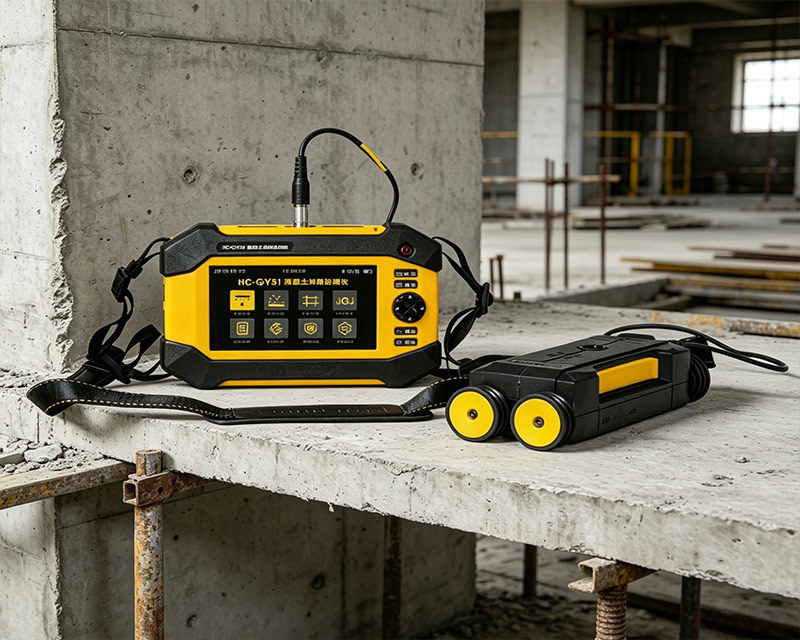
HC-GY31 Concrete Rebar Nondestructive Tester
Concrete rebar detectors are primarily used to determine the location, distribution, and orientation of reinforcing steel in concrete structures, as well as to measure the concrete cover thickness and rebar diameter.
HC-GY62 Integrated Portable Nondestructive Rebar Scanner
The HC-GY62 integrated rebar scanner is a portable device.
HC-GY71S Portable Intelligent All-in-One Nondestructive Rebar Scanner
The HC-GY71S rebar scanner is a portable, intelligent nondestructive testing device used to assess the construction quality of reinforced concrete structures.
HC-GYS1 Rebar Scanner Calibration Blocks (Φ16 and Φ22 threaded rebar; Φ10 round steel)
The integrated rebar scanner calibration test block features an all‑in‑one structural design, ensuring long-term stability.
HC-GYS2 Rebar Scanner Calibration Test Block (Φ16 Rebar)
This simple test block for measuring rebar cover thickness features an adjustable spacing and is compatible with various rebar sizes.
HC-GYS3 Rebar Scanner Calibration Block (Φ16 Round Rebar)
It features a detachable coplanar support block design and is constructed entirely from non-magnetic materials.
HC-GYS4 Rebar Scanner Calibration Block (Φ20 Rebar)
The device features a detachable, pull-out design and is manufactured from non-magnetic materials using CNC machining, enabling it to simulate stirrups for realistic testing. Reinforcing bars can also be arranged in a crossed configuration to replicate the behavior of stirrups.
HC-GYS5 Rebar Scanner Calibration Block (Φ10 Rebar)
Prior to the commissioning of a new instrument, following major component maintenance or replacement, and whenever abnormal data are detected during testing, the rebar detector shall be calibrated using this calibration block to ensure the accuracy and reliability of its measurement results.
HC-HD91 Integrated Floor Thickness Gauge
The HC-HD91 integrated floor‑slab thickness gauge is primarily used to measure the thickness of concrete structures such as floor slabs, shear walls, beams, and columns, as well as non‑magnetic materials like wood and ceramics.
HC-LJ10 Integrated Wall Tie Tester
The HC-LJ10 wall tie strength tester is used to assess the strength of wall ties.
HC-MD60T High-Precision Rivet Pull-Out Testing Machine
It is suitable for testing the pull-out resistance of rivets used to secure thermal insulation materials in construction projects, the bond strength of wall insulation materials, and the bond strength of exterior wall facing tiles, various types of panels, coatings, and other materials.
HC-MG01 Wireless Anchor Pull-Out Tester
It is used to test the pull-out resistance of anchors, reinforcing steel, expansion bolts, and other anchoring components, as well as to measure their displacement, making it an indispensable testing instrument for evaluating anchoring construction and support engineering.
Whether you want to customize product features
I still need some examples to refer to ——
Please let us know what you're looking for, and we'll send you relevant materials to help you move your project forward quickly!
Global Partners
Customer Satisfaction
Committed to becoming a leader in China's testing equipment manufacturing industry
Share To


Contact Us
Mobile:+86-15102211717
Whatsapp:+86-15102211717
E-mail:lbt@lbt.ltd
Address:Tianjin Jinghai Economic Development Zone