







Lb-DRV Multifunctional Thermal Conductivity Tester for Solid Insulating Materials (Hot‑Flow Method)
Keywords:
E-mail:
WhatsApp:
Description
Product Introduction:
The Lb-DRV multifunctional thermal conductivity tester for solid insulating materials is primarily used to measure the thermal resistance of thin thermal conductors, thermally conductive silicone sheets, thermally conductive resins, beryllium oxide ceramics, alumina ceramics, and other small‑dimensional materials, as well as the contact thermal resistance at solid interfaces and the thermal conductivity of the materials themselves. The test specimens are typically solid, sheet‑like samples; with an appropriate frame, powdered or paste‑like materials can also be tested.
Reference standard:
MIL-I-49456A (insulating sheet, thermally conductive resin, thermally conductive glass-fiber reinforced);
GB 5598-2015 (Method for Determining the Thermal Conductivity of Beryllium Oxide Ceramics—Rod‑Axis Method);
ASTM D5470-12 (Standard Test Method for Thermal Conductivity of Thin Solid Electrical Insulating Materials),
GB/T 38712-2020 (Test Method for Thermal Conductivity of Ultra-Thin Glass—Hot-Plate Method),
GB/T 29313-2012 Test methods for thermal conductivity of electrical insulating materials.
Key features:
1. A protective thermal device has been added around the test rod inside the testing head (this device provides thermal protection for the specimen), thereby expanding the instrument’s temperature measurement range and reducing the influence of ambient temperature on the test results.
2. A thermocouple array for measuring temperature differences in the heat‑flow test has been added to the test rod inside the probe, enhancing the resolution, accuracy, and repeatability of heat‑flow measurements.
3. The use of an ice–water mixture for thermocouple cold-junction compensation has been eliminated, simplifying operation and enhancing user convenience.
4. Added experimental methods such as “aging reliability testing,” “high‑thermal‑conductivity material testing,” and “inter‑sample contact thermal resistance testing.”
Technical Specifications:
| Parameter Category | Parameter content |
| Temperature range | 1. 20–80°C (Hot end: room temperature–100.00°C; Cold end: 0–80.00°C, for a constant-temperature bath) 2. 20–140°C (Hot end: room temperature–200.00°C; Cold end: 0–80.00°C, in a constant-temperature bath) 3. 20–190°C (Hot end: room temperature–300.00°C; Cold end: 0–80.00°C, in a constant-temperature bath) 4. 100–260°C (Hot range: 120.00–300.00°C; Cold range: 80.00–240.00°C, temperature control) 5. -20 to 80°C (hot end: room temperature to 100.00°C; cold end: -40.00 to 60.00°C, in a constant-temperature bath) 6. 40–260°C (Hot end: room temperature–500.00°C; Cold end: 0–80.00°C, in a constant-temperature bath) Note: The temperature range refers to the range of the test sample’s average temperature (measured on both the hot and cold faces). The hot-face temperature is slightly lower than the hot‑plate temperature, while the cold-face temperature is slightly higher than the cold‑plate temperature. When selecting a model, choose based on one of these parameters. |
| Thermal conductivity | 1. Normal mode: 0.1–45 W/m·K, 2. High‑thermal‑conductivity mode: 5–500 W/m·K (with a high‑thermal‑conductivity test module). |
| 3. Thermal Resistance Range | 0.05–500 (cm²·K/W) |
| 4. Test Accuracy | 1. Thermal resistance testing: 10–500 cm²·K/W, with an error of ≤3%; 0.05–10 cm²·K/W, with an error of ≤5%. 2. Thermal conductivity measurement: 0.1–5 W/m·K, with an error of ≤3%; 5–500 W/m·K, with an error of ≤5%. 3. Thermal contact resistance test: error ≤ 5% 4. Thermal resistance testing of aluminum-based substrates (composite panels): Error ≤ 5% ± 0.1 |
| 5. Test head dimensions | 1. Φ30 mm (the specimen size is based on this test head as an example); 2. Φ50 mm (optional) |
| 6. Specimen Dimensions | 1. 0.1–5 W/m·K or 10–500 cm²·K/W, Φ30 × (0.2–5) mm, with stackable thickness options. 2. 5–45 W/m·K or 2–10 cm²·K/W, (Φ20–Φ30) × (0.2–15) mm 3. 5–500 W/m·K, (Φ10–Φ30) × (15–30) mm (high‑thermal‑conductivity mode) 4. Aluminum substrate: 15×15 (mm) Note: The dimensions of this specimen are nominal; refer to the following instructions for detailed specimen preparation dimensions. |
| 7. Pressure Measurement | 0–1000.0 N, with electric loading provided by a geared motor and measured using a high-precision pressure sensor. |
| 8. Displacement Measurement | 0–40.00 mm; a high-precision displacement sensor is used to measure the sample thickness. |
| 9. Pressure Control | Electric |
| 10. Experimental Method | 1. Thermal resistance testing of the sample under different pressures, 2. Thermal conductivity testing of materials, 3. Contact thermal resistance testing under different medium pressures, 4. Thermal resistance testing of aluminum-based substrates (composite panels), 5. Aging reliability testing, 6. Thermal conductivity testing of high‑thermal‑conductivity materials (with a high‑conductivity test module). 7. Indirect contact thermal resistance testing of specimens under different pressures (with a contact thermal resistance test module). 8. Material compression performance testing (new feature). |
| 11. Host Power Supply | Voltage: 220V, power less than 1kW. |
Instrument configuration:
One host unit of the Lb-DRV multifunctional solid insulation material thermal conductivity tester; one set of testing software (including communication interface); one set of constant‑temperature bath (either a constant‑temperature water bath or a constant‑temperature oil bath, configured according to the selected temperature range) together with its controller; one computer; one set of measurement leads; one quartz standard sample; and two frames for colloidal samples.
Related Product
WSC-300 Microcomputer-Controlled Steel Strand Stress Relaxation Testing Machine
The WSC-300 microcomputer-controlled steel strand stress relaxation testing machine employs servo control technology and computer-based data acquisition and processing, enabling closed-loop control and automated testing. It comprises four main components: the testing frame, the servo control system, the measurement and control system, and the test fixtures. With a maximum test force of 300 kN, the machine achieves an accuracy class better than 0.5.
YLZ-100 Microcomputer-Controlled Electro-Hydraulic Servo Curbstone Flexural Testing Machine
The YLZ-100 concrete curbstone flexural‑compressive testing machine is used to determine the flexural strength and flexural load of linear curbstones with a length of 1000 mm, as well as the compressive strength of curved curbstones and L‑shaped curbstones with a straight cross‑section. In accordance with JC/T 899‑2016 Concrete Curbstones, it can also be employed to conduct experimental studies on the flexural and compressive strengths of other materials.
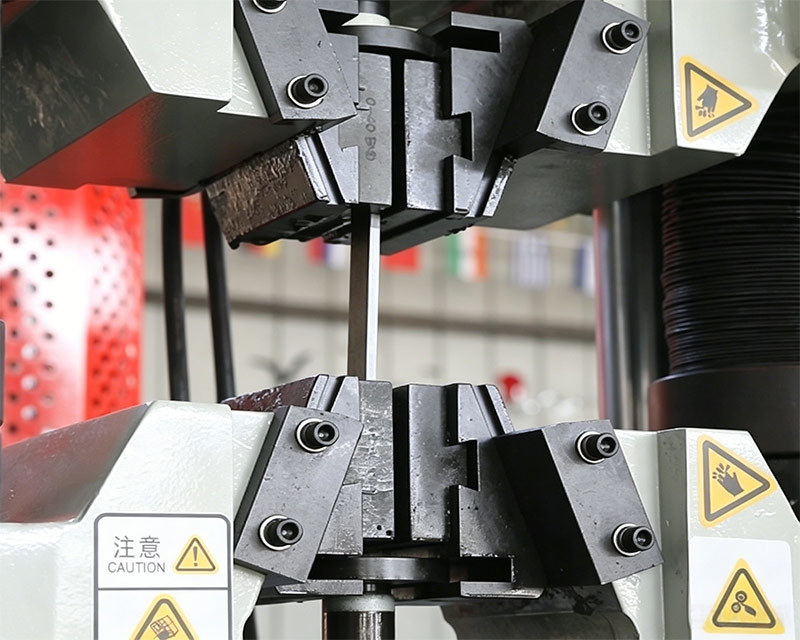
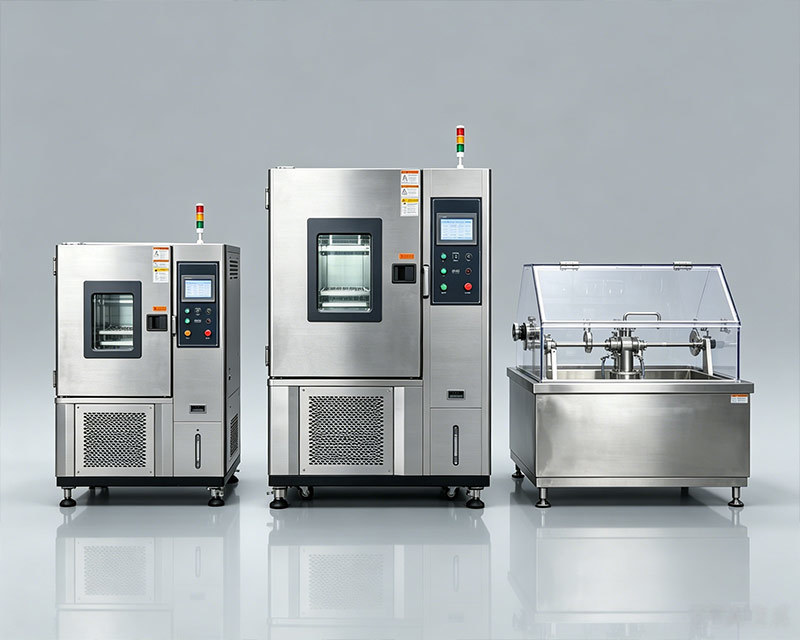
The microcomputer-controlled high‑ and low‑temperature electronic universal testing machine consists of the testing machine mainframe, fixtures, a high‑ and low‑temperature chamber, and computer software. The temperature chamber is slid into the mainframe; after opening the chamber door, the specimen is secured in the dedicated fixture. The chamber then heats or cools until the specified temperature is reached.
WDW—Dual-Column Microcomputer-Controlled Electronic Universal Tensile Testing Machine (20 kN)
This machine can perform tests such as tensile, compressive, flexural, tear, 90° peel, 180° peel, shear, adhesion, pull-out force, and elongation at break on rubber, plastics, foamed materials, synthetic resins, films, alloy materials, and other non-metallic and metallic materials.
FAQs


Customer Reviews
Southeast Asia Rubber & Polymer Factory|Purchase: Vicat Softening Point & Tensile Testing Machine
2026.06.05
★★★★★
Middle East Construction Lab|Purchase: Universal Electronic Testing Machine & Geotextile Test Equipment
2026.06.05
★★★★★
European Plastic Pipe Manufacturer|Purchase: Ring Stiffness & Hydrostatic Burst Tester
2026.06.05
★★★★★
Consult
We will contact you within one working day. Please pay attention to your email.
Keywords:
Lb-DRV Multifunctional Thermal Conductivity Tester for Solid Insulating Materials (Hot‑Flow Method)
Whether you want to customize product features
I still need some examples to refer to ——
Please let us know what you're looking for, and we'll send you relevant materials to help you move your project forward quickly!
Global Partners
Customer Satisfaction
Committed to becoming a leader in China's testing equipment manufacturing industry
Share To


Contact Us
Mobile:+86-15102211717
Whatsapp:+86-15102211717
E-mail:lbt@lbt.ltd
Address:Tianjin Jinghai Economic Development Zone